Section one
What this figure is
Raphael is one of only three angels the Church names with assurance, and the only one whose story is told at length as a story. Michael is given visions and battles, Gabriel annunciations, and Raphael chapters of travel, courtship, illness and healing.
His name means God has healed, and the name is the work. He appears in the book of Tobit, a Jewish work of the second century before Christ, and in the older 1 Enoch. In Tobit he speaks of himself as one of seven who stand in the presence of the Lord.
The setting is the eighth century before Christ, in exile. Tobit, old and devout, living in Nineveh, has been blinded. He has money in safekeeping with a kinsman in Media, and would send his son Tobias to fetch it, though Tobias does not know the road.
Raphael offers himself for the journey and gives a name that is not his — Azariah, son of Ananias, of your kinsmen. Tobias sets out beside an archangel he takes for a man, and only the reader knows who walks with him.
Section two
The moment in the sculpture
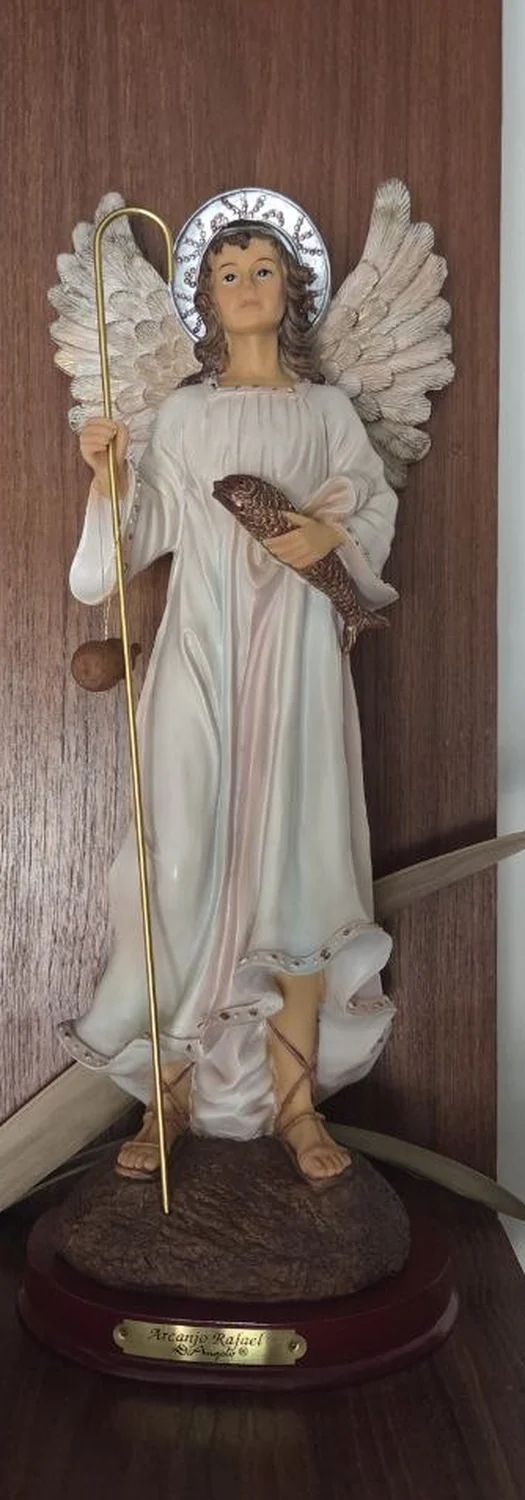
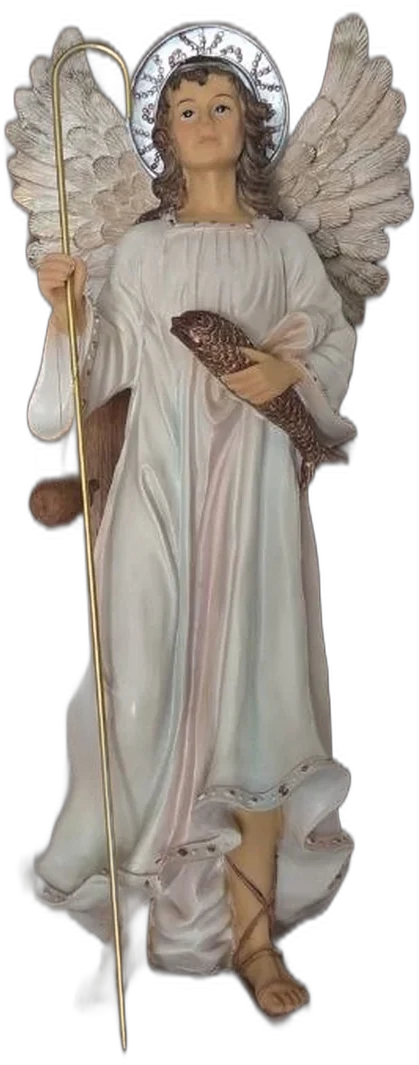
Consider what this figure carries, for it decides what kind of image this is. In his right hand is a tall staff of gold with a curved head and a small travelling pouch; against his breast, in his left arm, he holds a fish.
The fish is the clue that makes this a scene rather than a portrait. Everything else about Raphael could belong to any angel. The fish fixes the image to one afternoon on the bank of the Tigris.
He is dressed as a traveller and not as a warrior. Where Michael bears armour and a raised sword, Raphael carries a walking staff, a pouch and open sandals strapped at the ankle — painted with care, because they are part of the meaning.
A gold plate on the pedestal reads Arcanjo Rafael, Archangel Raphael in Portuguese, with a second line naming the workshop, D'Angelo — a Portuguese devotional piece: the same kind of object that once travelled in a crate to Goa or Kochi.
Section three
What the objects mean
Four elements identify Raphael, and three of them come from one journey.
The fish is the most eloquent, for the book gives it three uses while the statue shows only the creature. It is caught at the companion's instruction; its heart and liver are burned to drive away a demon; its gall restores an old man's sight.
The halo, ringed and decorated
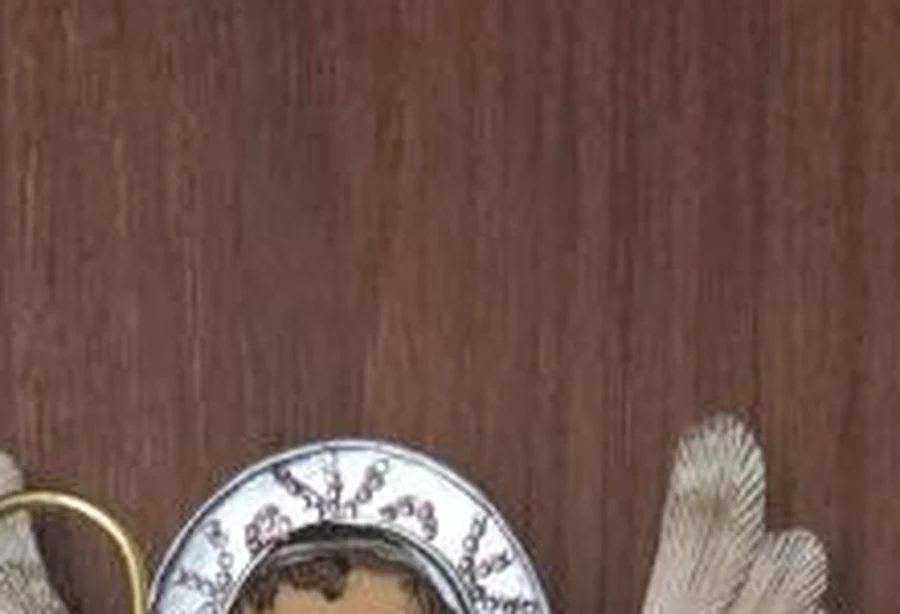
A circular nimbus with a silver and blue decorative rim, behind dark curly hair.
A halo marks a holy being. The decorated ring, rather than the plain gold disc given to the human saints of this collection, distinguishes an angel from a departed soul: Raphael is living, in the sense in which angels live.
The fish
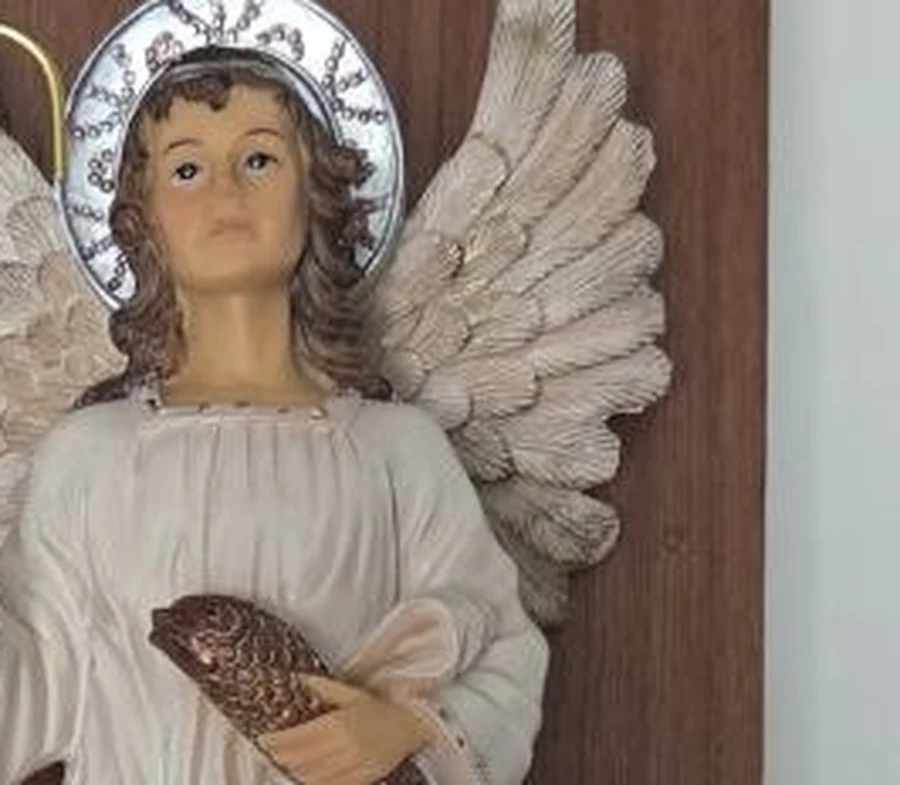
Held against his chest in the left arm — dark bronze-brown, detailed and unmistakable.
Tobit 6 tells of a fish that leaps from the Tigris and is taken at the companion's word. Its heart and liver burned drive off the demon; its gall, laid on Tobit's eyes, restores his sight. One creature working an exorcism and a cure makes him patron of healing.
The staff and the pouch
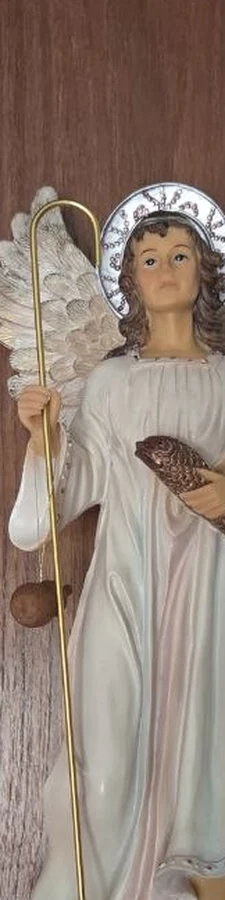
A tall gold staff with a curved head, a small pouch hanging from it, sandalled feet beneath.
The gear of a man hired to walk to Media and home again. The staff is Raphael's ordinary attribute and the reason travellers take him with them.
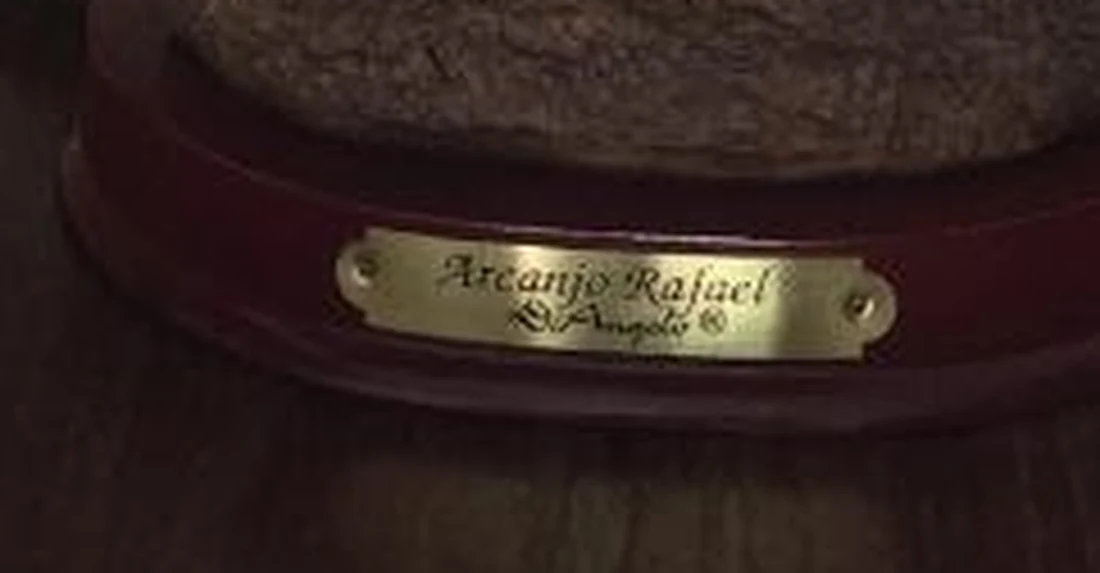
Arcanjo Rafael — and the workshop
A small gold plate with two lines of engraving on the front of the pedestal.
The first line names the figure in Portuguese; the second names the workshop that made it. Pieces of this kind are dated and located by their plaques more surely than by their style.
Section four
What Scripture says, and what it does not
Raphael's story is in the Bible, with one great qualification. The book of Tobit is deuterocanonical: it stands in the Catholic and Orthodox canons and in the Latin Vulgate, but not in the Protestant canon, and not in the Hebrew Bible. Much of the Christian world has therefore never met him.
The story is domestic and particular. Sarah, the woman Tobias marries, has lost seven husbands already, each taken on the wedding night by the demon Asmodeus. At Raphael's word Tobias burns the fish's heart and liver in the bridal chamber, and the smoke drives Asmodeus away to Egypt.
Then the companion departs. Pressed to accept half the money and the livestock, he takes them aside and says: I am Raphael, one of the seven angels who stand in attendance and enter the presence of the glory of the Lord. They fall on their faces, and he bids them praise God and not him.
Two matters of honesty belong here. Raphael is not named anywhere in the New Testament; his identification with the angel at the pool of Bethesda is a later tradition. Tobit, too, is devout instruction rather than chronicle, and its worth lies in what it shows of that faith.
I am Raphael, one of the seven angels who stand in attendance and enter the presence of the glory of the Lord.
Tobit 12:15
Section five
Why it sits on a shelf
Raphael is the figure people carry with them. His first patronage is travellers, which makes him the guardian of the packed bag: the statue that moves from a shelf to a suitcase when someone flies. He is patron too of the sick.
His patronage of healing is unusually precise. He is invoked for diseases of the eye, for illness of every kind, for troubled minds and against nightmares, and he is patron of physicians, pharmacists and nurses — the only archangel with a professional bond to medicine.
The Portuguese plate completes the story. Such figures came from workshops that supplied households, parishes and missions across Portugal, Brazil, Goa and the Malabar coast, and somewhere in Kerala a church holds a Raphael that travelled by the same route.
In ordinary practice he is often set beside Michael. Michael guards against evil; Raphael heals what evil and misfortune have already done.
For a journey
Saint Raphael, companion of Tobias on the road, you were sent to heal and to guide, and you kept your name hidden while you did it. Walk with those who are travelling, hold steady those who are sick, and bring the ones we love home safely. Amen.
The traditional formula for travellers asks for the archangels' company on the road: "Michael, Gabriel and Raphael, be with me on this journey." Raphael's association with safe travel comes directly from Tobit.