Section one
Who this figure is
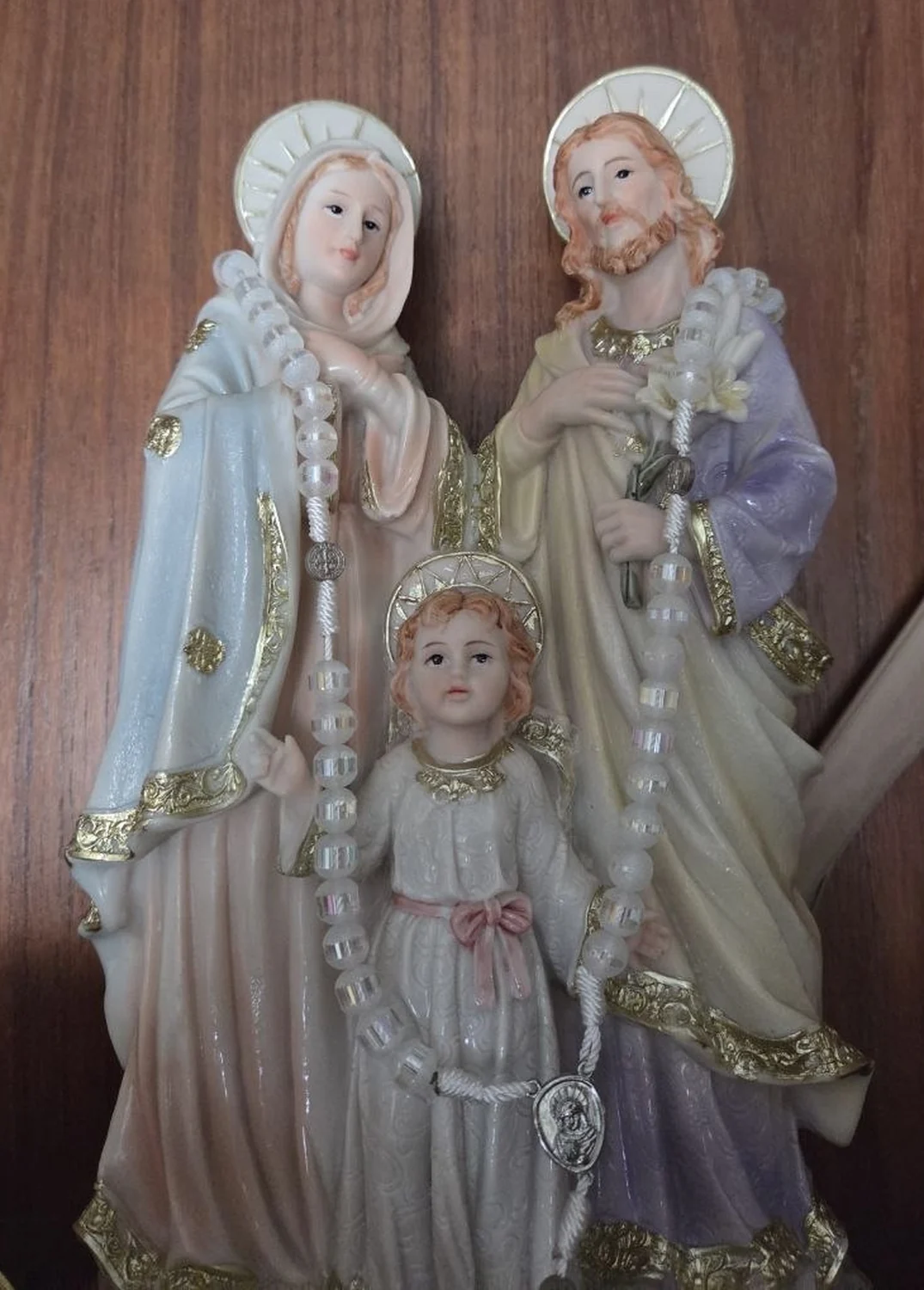
This figure differs from every other in the collection, because it is not a saint but a household: three persons whose whole significance lies in how they stood beside one another — a young woman, a carpenter, and a child.
Mary of Nazareth is the mother, honoured by the Church with the Greek title Theotokos, God-bearer, settled at the Council of Ephesus in 431. Joseph is the carpenter named in Matthew and Mark, and devotion holds him patron of workers, of fathers, and of a happy death.
The child in the centre needs no introduction, but he asks for one observation. In a sculpture such as this he is never shown as a baby in arms. He stands alone, a little before the adults, and their hands do not hold him up: the artist is telling us who is the heart of this house.
Section two
The moment in the sculpture
There is no moment here, and that is the first thing to notice. Nearly every other figure on a Catholic shelf holds a scene still — a sword raised, a dragon beneath the feet, a fish in the arm. This group holds nothing still. It is a portrait of a household at peace, and its subject is not an event but a way of living.
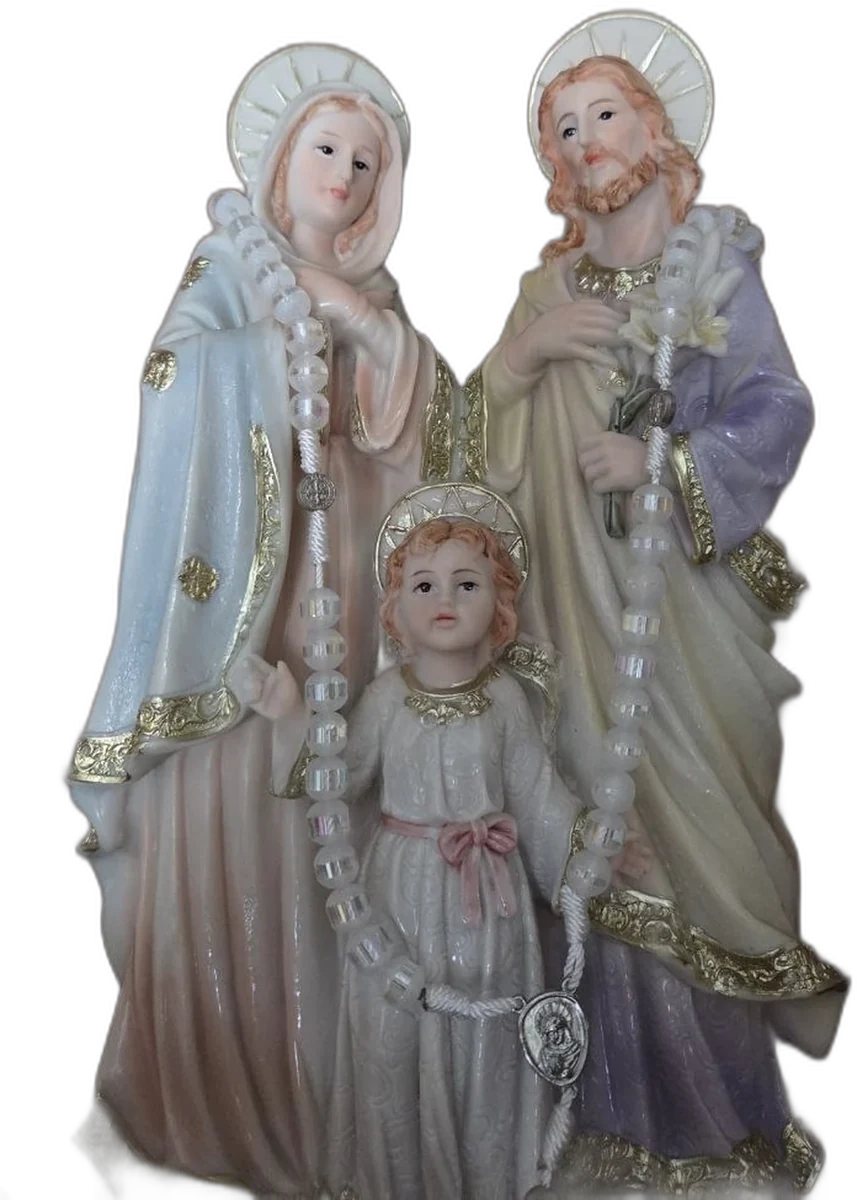
The sculptor has joined three figures into one by three means. The first is the halos: all three carry a radiating gold disc, so that the eye reads a single object rather than three. The second is colour, bound at the hem by the same gold scrollwork on all three garments.
The third is the most telling, and the easiest to pass over. One rosary is draped through the whole group: it falls from Mary's hand, passes before the child, whose hands rest upon it, and is taken up by Joseph. No one holds a rosary of his own. They hold one another's, and that is the argument of the piece.
He went down with them and came to Nazareth, and was obedient to them. His mother kept all these things in her heart. And Jesus increased in wisdom and in stature and in favour with God and man.
Luke 2:51–52
Section three
What the objects mean
Nothing on this piece is merely ornamental. Each element is doing work, and the work is older than the sculpture by centuries.
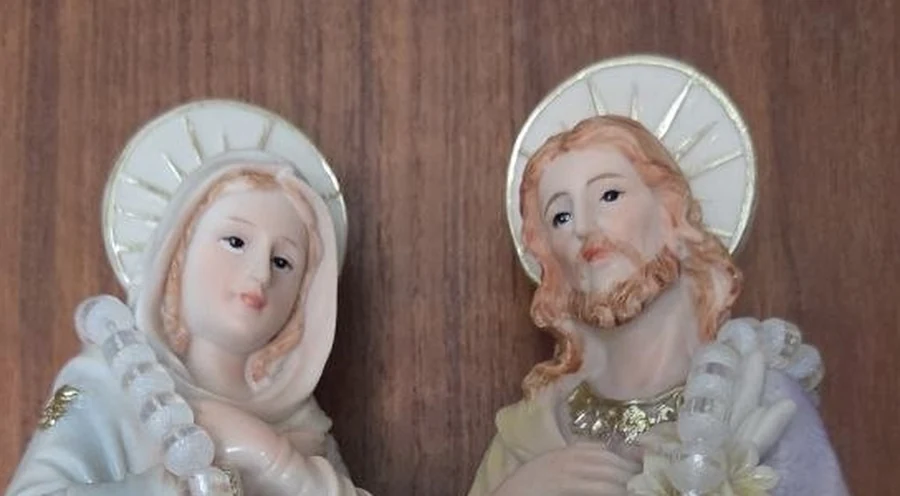
Begin with the halos, which carry a distinction that is easily flattened. Two of them are plain discs. The child's is not: it is a pointed, cross-bearing nimbus, a shape Christian art reserves for a divine person. Three halos stand in a row, and one of them is a different kind of thing.
Three halos, two kinds
The two adults carry plain radiating discs. The child's halo is pointed, a cruciform nimbus.
In Christian iconography the plain disc marks a saint, while the pointed or cross-bearing nimbus marks a divine person. In a single glance the sculpture says that this whole family is holy, and that the child is something more.
The lilies in Joseph's hand
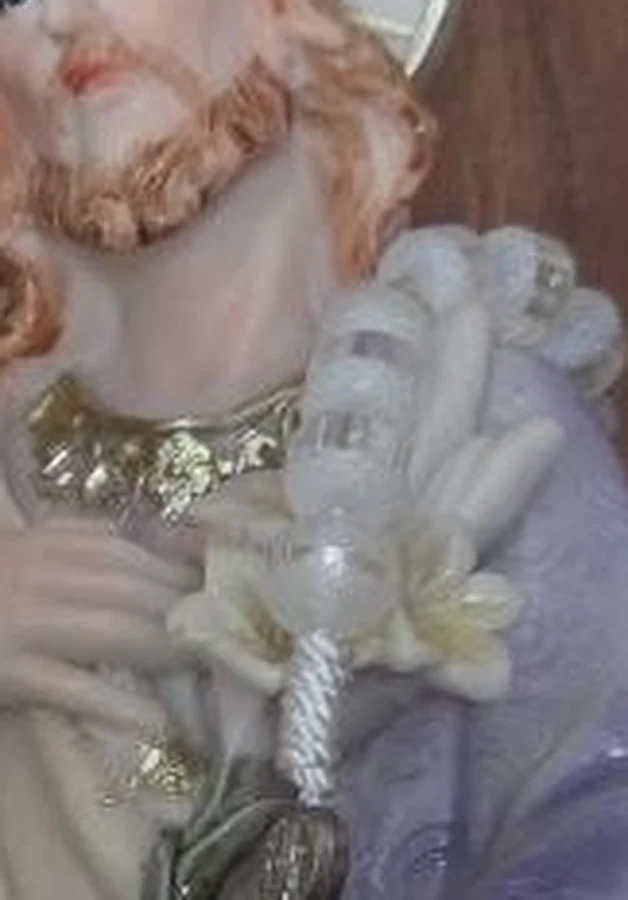
A stem of white lilies is held against Joseph's shoulder, alongside his end of the rosary.
Lilies are Joseph's attribute, signifying chastity, and behind them lies an older story. In the apocryphal Protoevangelium of James the candidates for Mary's betrothal were gathered and Joseph's staff flowered, marking him as the chosen one. Every flowering staff or lily in his hand recalls that tradition.
The child at the front
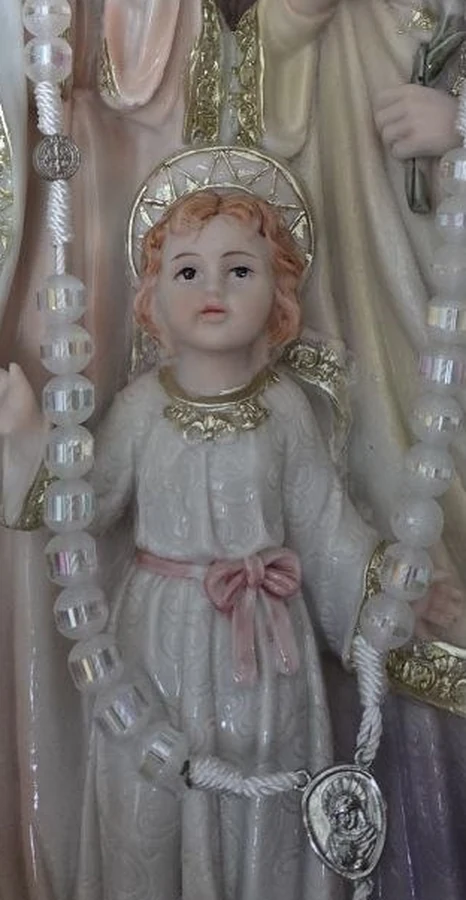
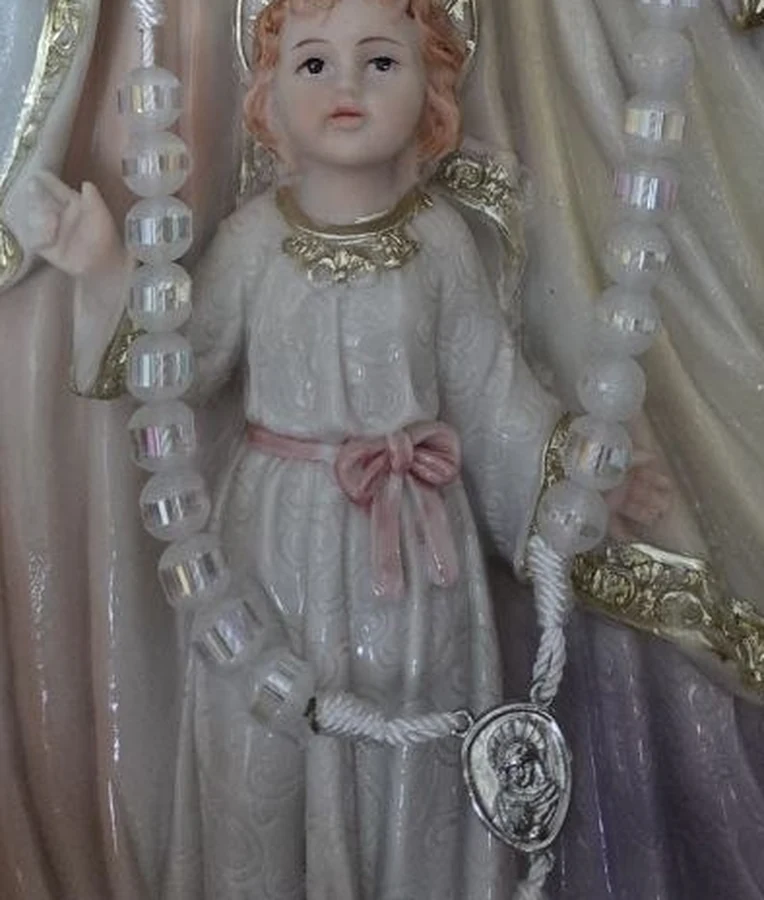
White robe, gold trim at the collar, a pink sash at the waist, hands resting on the shared rosary.
White is the garment of baptism, and the sash is a small domestic detail that keeps the figure from drifting into pure symbol. He is placed forward of the adults because he is the reason they are there.
One rosary, three pairs of hands
Faceted crystal beads on a white cord, with a single medal hanging at the base.
The rosary is not an ornament here but the structure of the piece. A single string passing through three sets of hands is the sculptor's way of saying that what held this household together was shared prayer.
Section four
What Scripture says, and what it does not
The Gospels are spare about the Holy Family as a family. Matthew 1–2 gives the genealogy, Joseph's dilemma, the birth and the flight into Egypt. Luke 1–2 gives the annunciation, the nativity, the presentation in the Temple, and one scene of the family twelve years later. Then the record falls silent for some eighteen years.
That silence is the most important fact about this devotion. The Church calls it the hidden life, and it is why a sculpture of three people standing still can be a religious object at all: the greater part of Christ's years were ordinary, domestic and unrecorded.
The one Gospel scene in which the family behaves as a family is the finding in the Temple, and it is a scene of real cost. Jesus remains in Jerusalem, his parents seek him three days in distress, his mother tells him plainly of their sorrow, and he answers with a question they do not yet understand. Luke records honestly that they did not comprehend what he said.
The group as sculpted — three equal standing figures, matching halos, a draped rosary, lilies in Joseph's hand — is not in Scripture. It is a devotional composition of the seventeenth century and later, made to be prayed before rather than read as narrative.
Section five
Why it sits on a shelf
This is the household figure of the collection. Where Michael stands by a door and Raphael travels in a bag, the Holy Family belongs wherever a family eats and rests and sleeps. The Second Vatican Council gave the home a name for this, calling the family the domestic church, and the phrase has endured because it names what Christian families had long been doing.
In practice the group serves two purposes. The first is marriage and anniversary, for it is the natural figure to set near a wedding photograph. The second is blessing, for the old custom of asking God's blessing on a new house is often prayed before this trio.
There is also a plainer reason they are kept. Sets like this were bought for a whole house rather than a single room, and among the familiar household figures this is the only one that gathers everybody: father, mother and child, the pattern of the Christian home.
Jesus, Mary and Joseph
Jesus, Mary and Joseph, I give you my heart and my soul. Jesus, Mary and Joseph, assist me in my last agony. Jesus, Mary and Joseph, may I breathe out my soul in peace with you.
One of the shortest and oldest household aspirations in Catholic use — three names, said in one breath. It is traditionally taught to children as a prayer for a good death.