Section one
What this figure is
Begin with the distinction. Michael is not a saint as Anthony and George are: they are human beings who died and were raised to glory. Michael is an angel, a pure spirit, venerated by the Church but never canonised, because there was no human life to examine.
His name is a confession. In Hebrew, Mikha'el means Who is like God? — and tradition has always heard it as the answer given to every pride that would set itself in God's place.
He is named in three books of Scripture. In Daniel he appears as the prince who defends Israel, promised to arise in time of anguish. In Jude he contends with the devil over the body of Moses and says only, May the Lord rebuke you. In Revelation he leads the armies of heaven against the dragon.
Such documentation is rare for an angel, and it is why Michael is one of only three whom the Church names with assurance. His feast is 29 September, held with theirs; until the reform of the calendar they were kept on separate days, and since 1969 in one celebration.
Section two
The moment in the sculpture
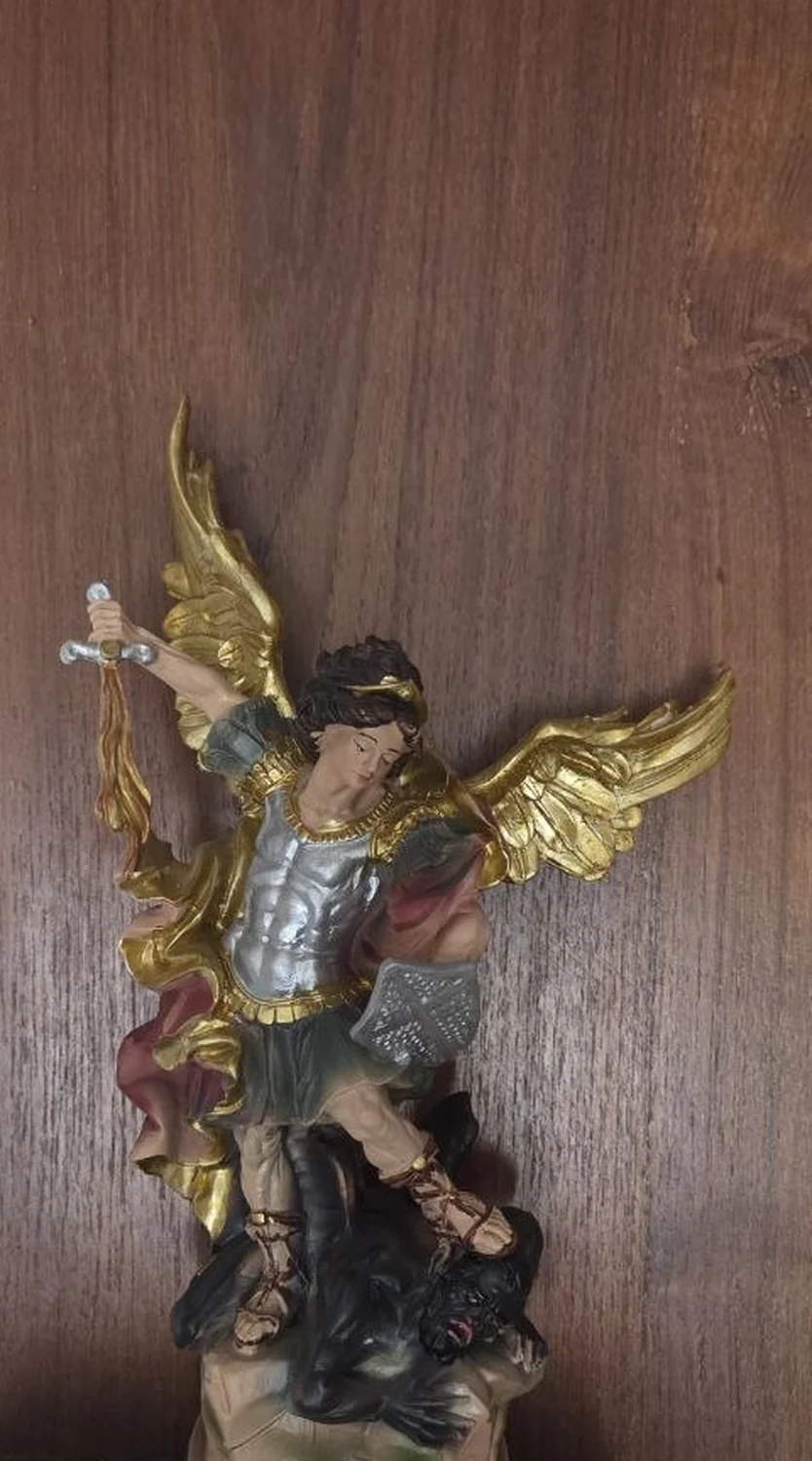
This figure does hold a moment still, and it is the gravest in the Christian vision of the world: the war in heaven of Revelation 12, Michael and his angels against the dragon, and the dragon cast down with no place left for him.
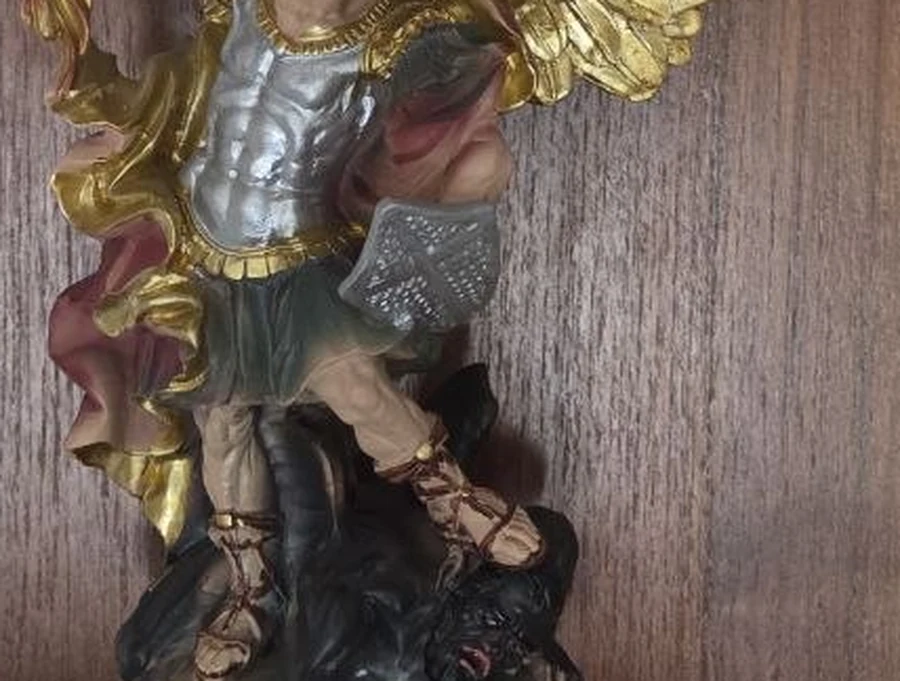
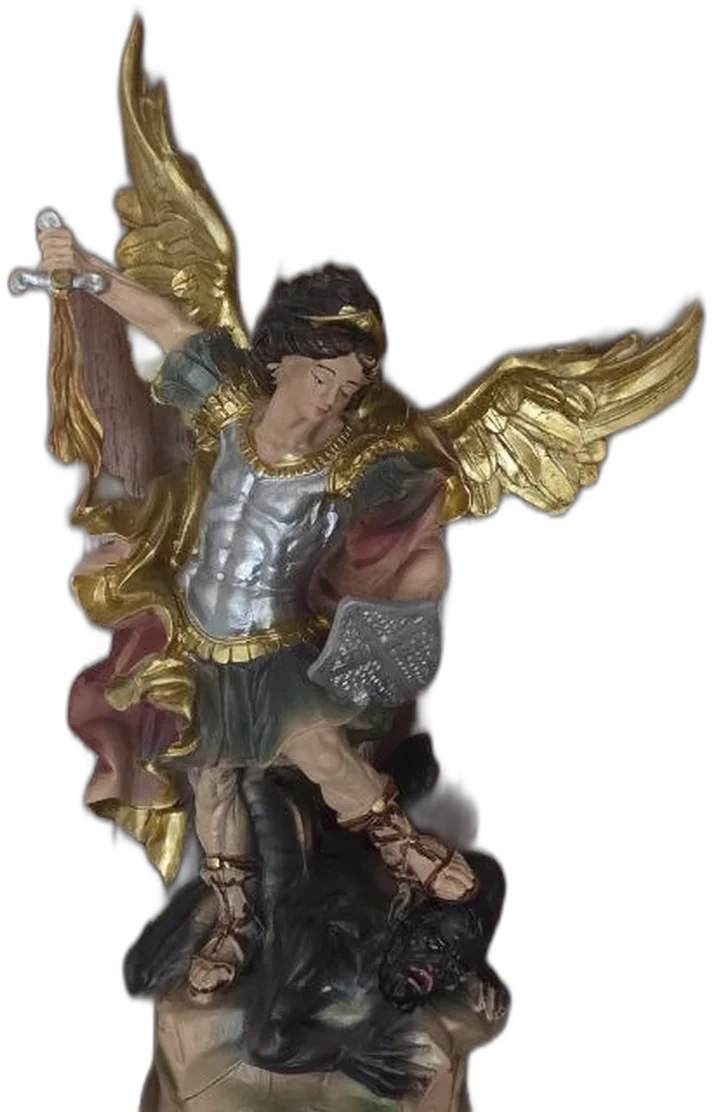
The sculptor has chosen the instant after the casting down and before the blow. Michael stands upon the creature, his right arm raised and the sword high, his left arm holding a small round shield; his foot is set upon the back of a dark, horned being driven into the rock.
The colour is quietly eloquent: silver armour with gold trim, a muted green tunic beneath, and a deep maroon cloak thrown back so that it streams behind. The gilt wings are the first thing the eye finds.
One absence is worth noting. Michael's second most common attribute is a pair of scales for the weighing of souls. This figure carries a shield instead: here he is shown as guardian rather than judge.
Section three
What the objects mean
Four attributes identify him, and each answers a different question.
The armour is the most striking, for it is Roman infantry equipment worn by a being who existed before Rome. It is no anachronism but a borrowing from the sixth chapter of Ephesians, where the faithful are told to put on the whole armour of God — the breastplate of righteousness, the shield of faith.
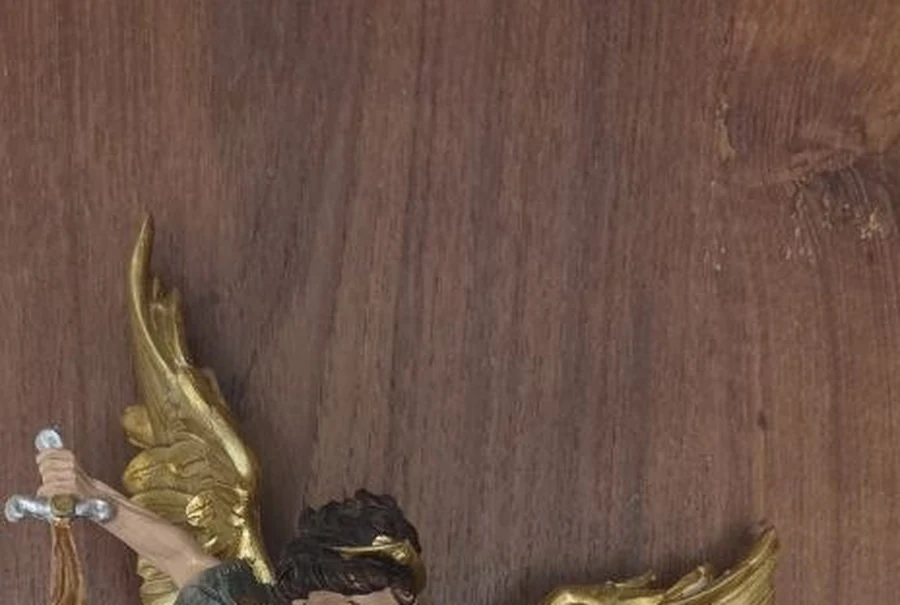
The gilded wings
Gold-feathered wings, sweeping outward and up, the widest element of the figure.
Wings are the sign of an angelic nature, a creature not bound by a body. The gold sets him apart from the human saints of this collection, who are painted in ordinary colours.
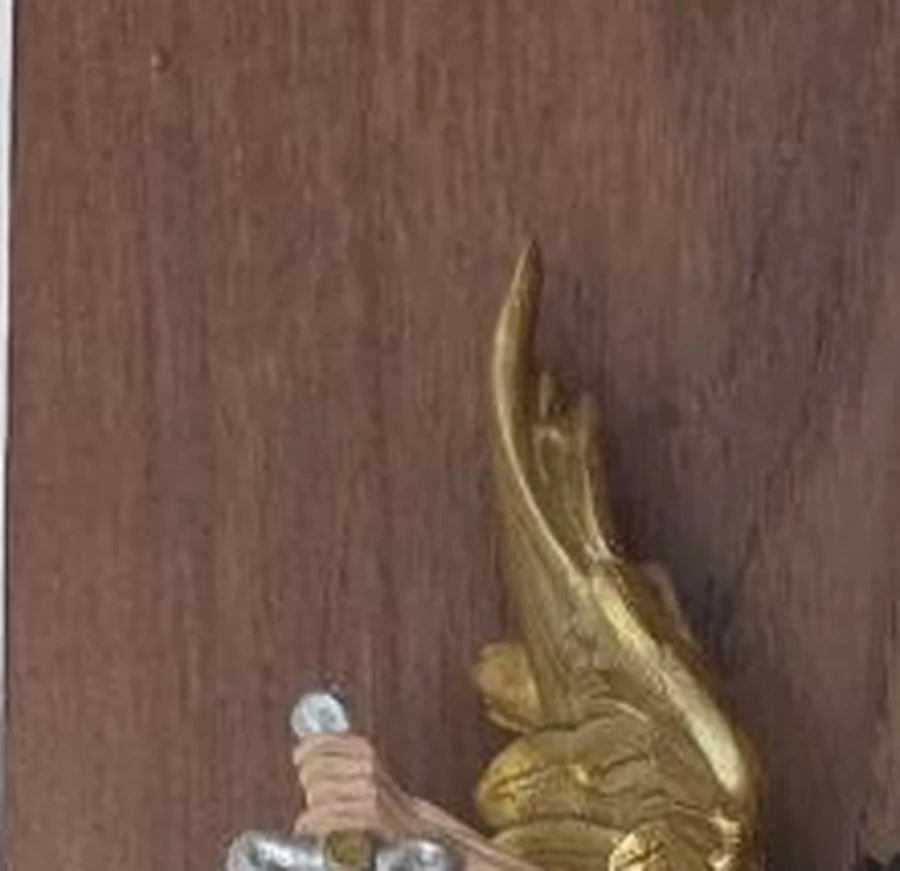
The raised sword
A silver blade held high in the right hand, with a gold cord and tassel at the grip.
The sword is the word of God in the language of Ephesians, and the instrument of the casting-out in Revelation. It is raised rather than swung: the figure shows authority given from above.
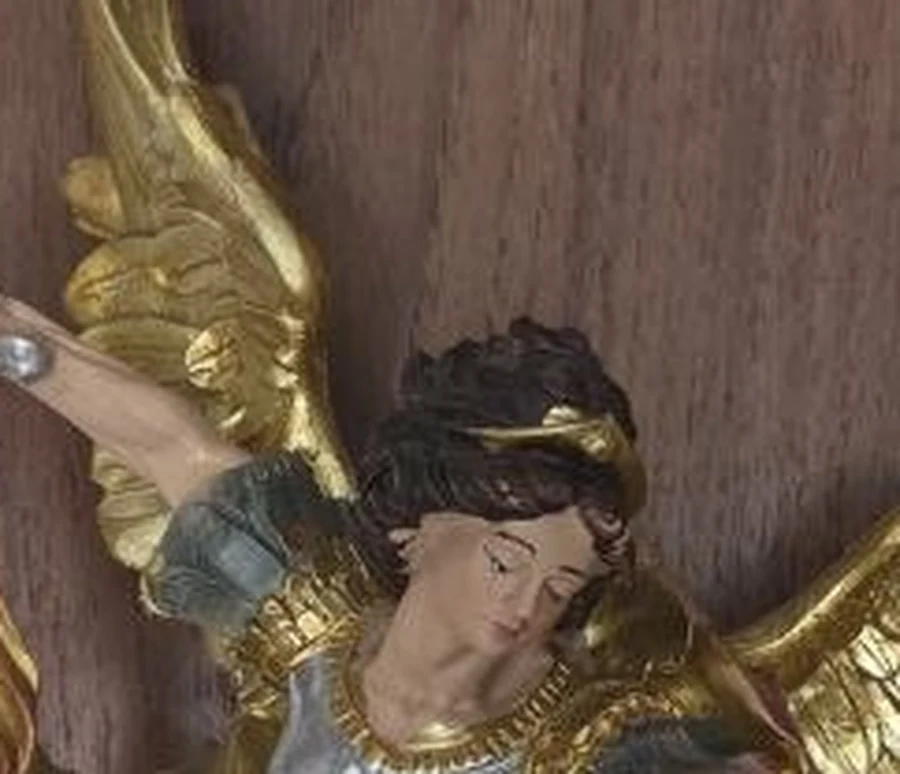
The breastplate and the shield
Silver breastplate with gold trim over a green tunic; a small round shield held on the left arm.
The breastplate of righteousness and the shield of faith, worn by the guardian of God's people. That this figure carries no scales of judgement is itself a statement: protection is what is asked of him here.
The devil underfoot
A dark, scaled, horned creature driven down into the base, one foot planted on its back.
Neither man nor beast, but a spirit given the shape of a reptile: the serpent of Genesis 3:15 with a heel upon its head, and the dragon of Revelation cast out of heaven.
Section four
What Scripture says, and what it does not
Michael is unusual in that every attribute may be traced to a text. It is still worth being precise about the kind of writing each is.
The Daniel passages are apocalyptic literature of the second century before Christ, describing a contest between angelic princes rather than a battle any mortal watched. The verse in Jude is a single sentence whose beauty is its restraint. The twelfth chapter of Revelation is a vision.
That naming is the key to the whole image. The dragon Michael opposes is the serpent of Genesis, the accuser of Job and the tempter of the Gospels, given a body so that a foot may be set upon it. A statue of Michael above a reptile is the whole biblical account of evil in one object.
What Scripture does not give is most of the detail people suppose: no description of his appearance, no account of his armour, no scene of a blow struck. The drama of the war in heaven is gathered from Revelation 12, from Isaiah 14 concerning the king of Babylon, and from a verse of Luke 10.
But when the archangel Michael contended with the devil and disputed about the body of Moses, he did not dare to bring a condemnation of slander against him, but said, "The Lord rebuke you!"
Jude 9
Section five
Why it sits on a shelf
Michael is the figure people place by a door, for the reason a house keeps a lock upon one. He is invoked against evil, against violence, against accident, and above all at the hour of death, which is why the prayer of Leo XIII asks him to defend us in battle.
He is also patron of ordinary work and of public order. Police and soldiers claim him, and so do bankers and grocers, through the old association with honest scales. His sanctuaries crown heights and islands, from Mont Saint-Michel to Monte Gargano.
In a home the uses are simpler and more intimate. He is protection, the answer to a child's nightmare, the figure set where children sleep, usually placed higher than the eye. And he holds a dignity no other figure here can claim: the others belong to the human story of birth and death, while Michael was present before the world was made.
The prayer of Leo XIII
Saint Michael the Archangel, defend us in battle. Be our protection against the wickedness and snares of the devil. May God rebuke him, we humbly pray; and do thou, O Prince of the heavenly host, by the power of God, thrust into hell Satan and all the evil spirits who prowl about the world seeking the ruin of souls. Amen.
Composed in the nineteenth century and traditionally said at the end of Mass in many countries. It is the most widely known prayer to any angel.