Section one
Who this figure is
His name was not Anthony. He was born Fernando Martins de Bulhões in Lisbon on 15 August 1195 to a noble family, and was educated at the cathedral school of his own city. At fifteen he entered the Augustinian canons at the abbey of Saint Vincent outside Lisbon.
What turned his life was the arrival of a corpse. Five Franciscans had been beheaded in Morocco, the first of their order to be martyred, and King Afonso II ransomed their bodies home to Coimbra. Fernando watched five poor friars carried in, and understood where he should be. He joined the Franciscans and took the name Anthony.
He then set out to do what had moved him, and was hindered at every step. He sailed for Morocco, fell gravely ill, and was shipwrecked on the voyage home. Too frail to be sent anywhere useful, he was given a hermitage at Montepaolo near Forlì.
In 1222, at an ordination at Forlì, no one was prepared to preach. The head of the house told Anthony to speak, he demurred, was overruled, and preached so well that his reputation was made in an afternoon. He preached through Bologna and Romagna, and within two years Saint Francis had entrusted him with the formation of the friars.
Section two
The moment in the sculpture
This is not a scene from the Gospel, nor even a public moment of his life. It asks us to consider what the book in his hand is for.
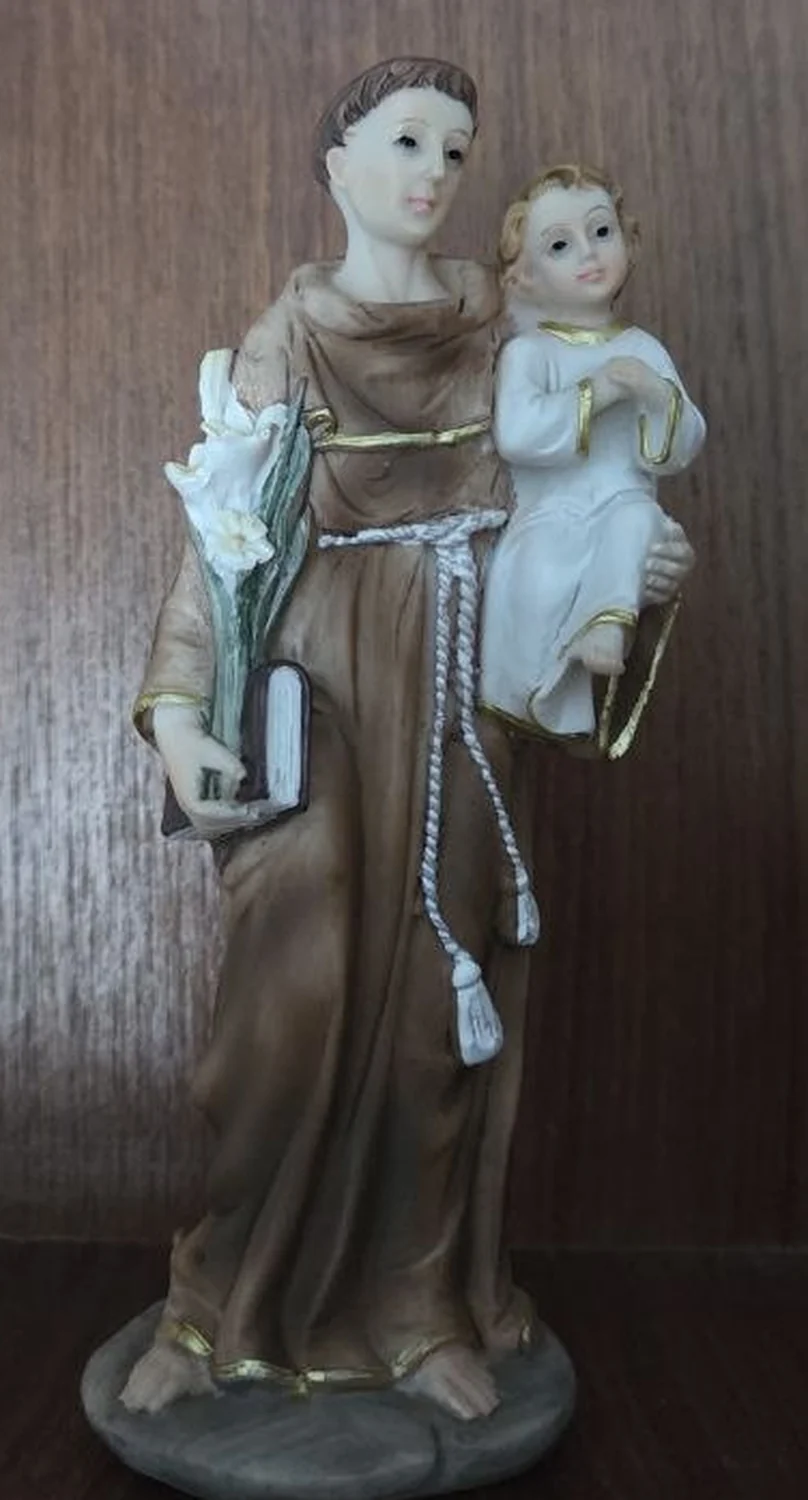
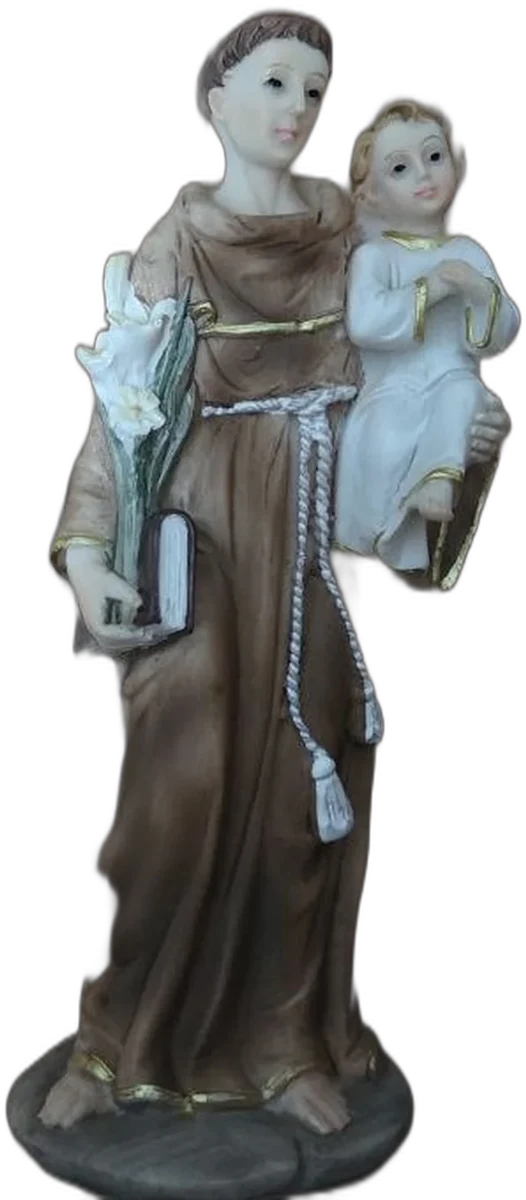
The figure stands in the brown Franciscan habit with the hood down, a white knotted cord at his waist, a closed book in his right hand with white lilies against it, and the infant Christ upheld in his left arm. The child stands against the saint's breast rather than lying in his arms: Anthony is presenting a person, not sheltering an infant.
The subject comes from the early lives of the saint rather than from Scripture. Anthony read and preached the word of God all his days, and the tradition grew that the Christ Child appeared to him while he studied — the Word made flesh, present to the man reading of him.
The earliest accounts add a tender detail. A man who had given Anthony lodging looked in upon him at night and saw a strange light and a boy with him. The apparition is recorded as something a guest observed, and the iconography keeps the guest's place.
Section three
What the objects mean
Four things are carried on this figure, and each is an attribute by which he may be recognised.
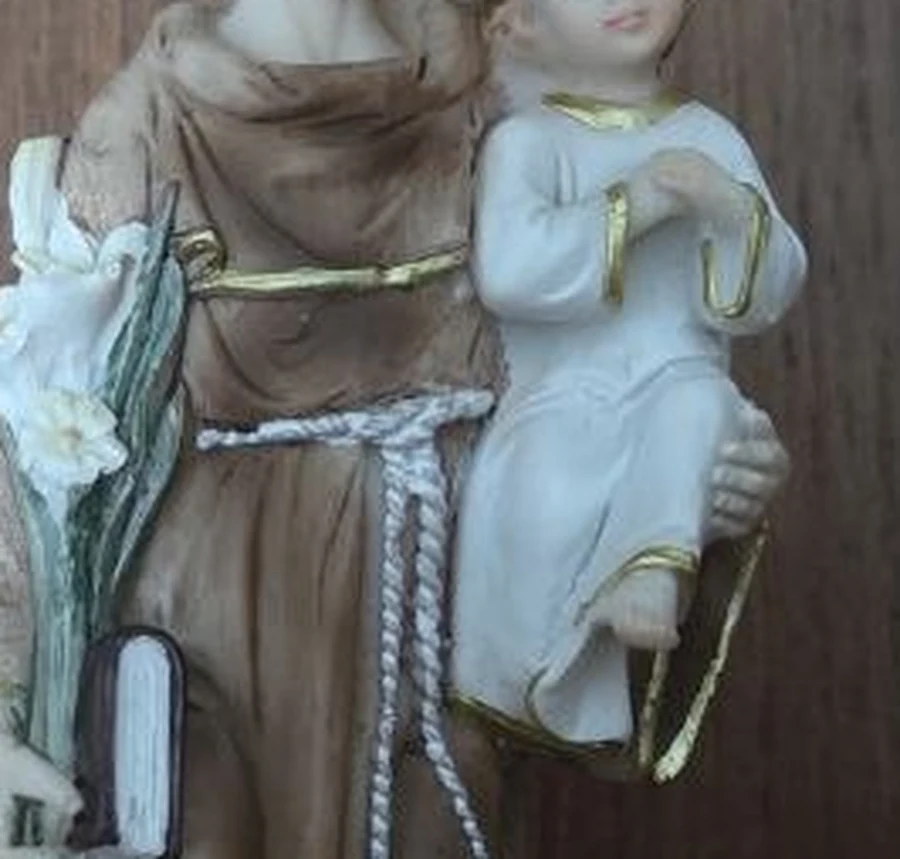
The cord deserves attention. A Franciscan's cord is not a belt but the oldest thing he wears, made of the cheapest material to hand, and its three knots are the three vows: poverty, chastity and obedience. Its unbleached white recalls the rope with which Christ was bound.
The head, and the hood
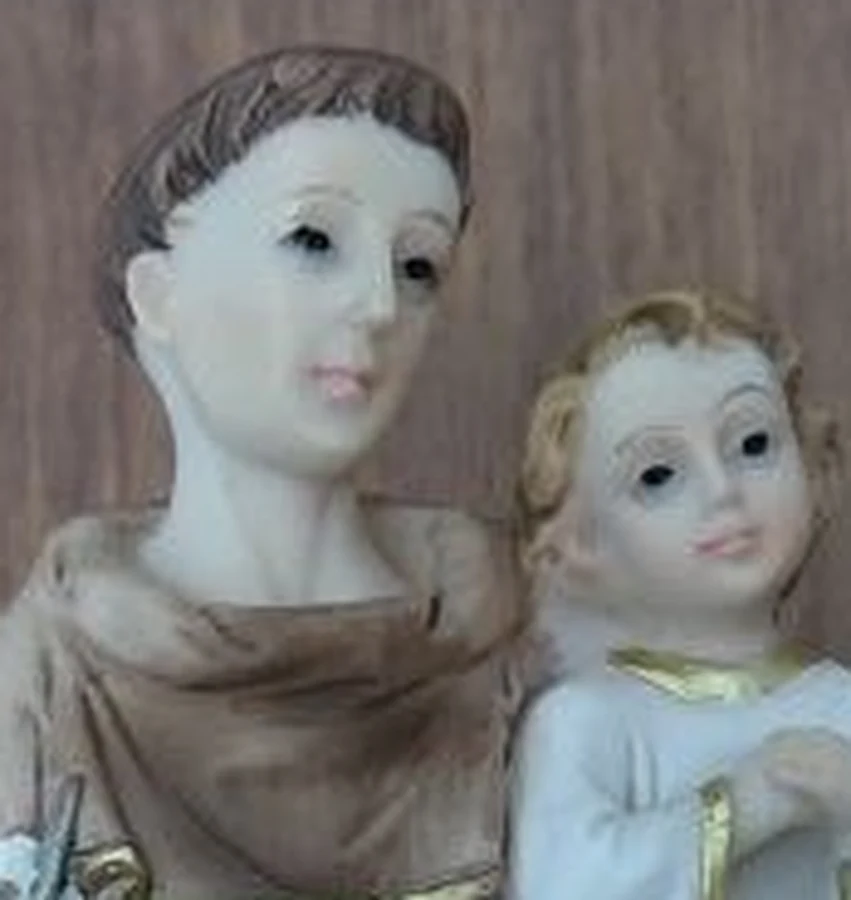
Short brown hair, a beardless, rather young face, the hood lying on the shoulders.
He died at thirty-five, and the tradition keeps him young. The beardless face and the hood worn down, rather than drawn up as a hermit's, mark him as a preacher who lived among people.
The book, and the lilies against it
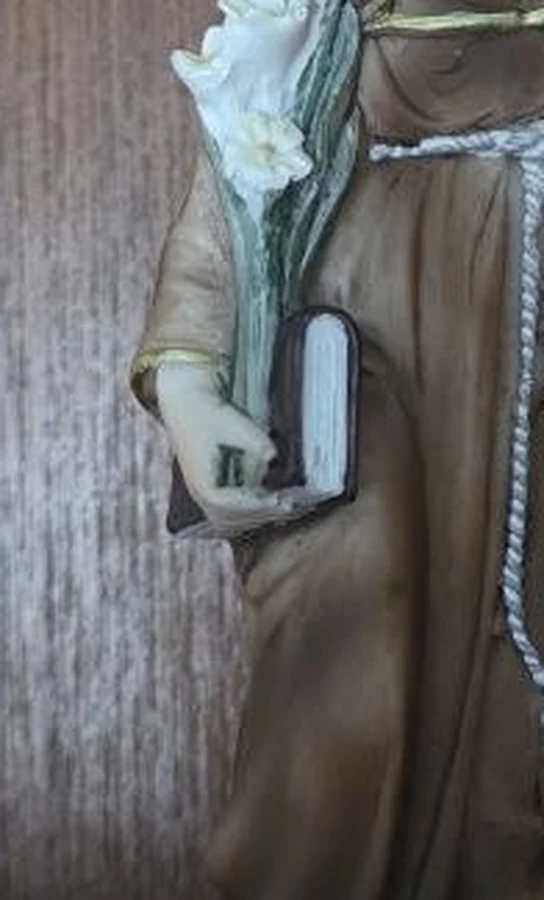
A small closed book with dark binding, a stem of white lilies held with it in the same hand.
The book is the psalter he copied by hand, the most cherished object of his life. The lily is the ancient sign of purity, and in his case the flower of the resurrection garden, held fresh-cut rather than growing.
The Christ Child
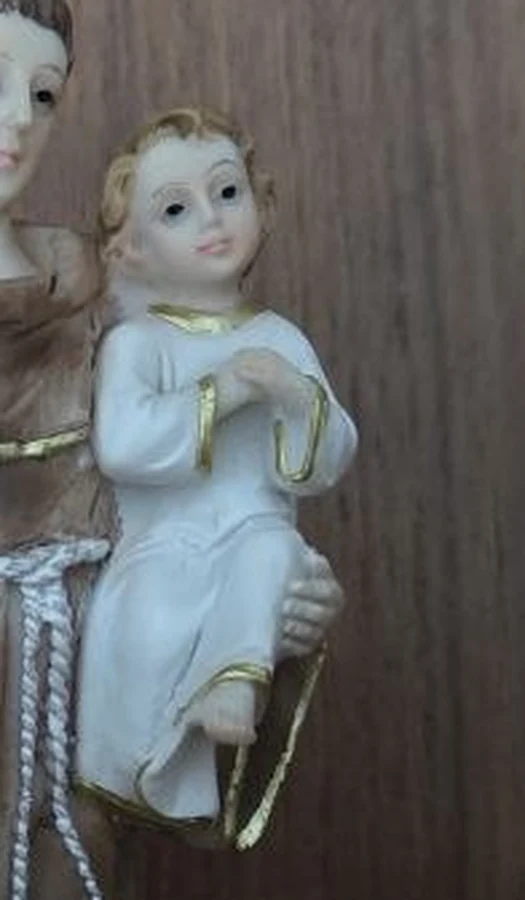
A small standing figure in white with gold trim, upheld in the crook of the saint's arm.
The child is the answer to the book. Anthony spent his life reading Scripture, and the tradition holds that the Word he read came to him in the room. This is why he is patron of those who look for what they cannot find.
The white knotted cord
A thick twisted cord at the waist with two tassels hanging loose.
A Franciscan's cingulum, worn in place of a leather belt as a sign of holy poverty. Its three knots are the vows of poverty, chastity and obedience, and its unbleached white recalls the rope used to bind Christ.
Section four
What Scripture says, and what it does not
Anthony is wholly post-biblical. He lived from 1195 to 1231, and the only Scripture in his story is the Scripture he read.
The famous detail is well attested. His psalter was precious to him because he had copied it himself, and a novice resolved to leave the order took it away. Anthony prayed for its return, and the novice came back with the book — and returned to the order as well.
The wondrous accounts of his preaching belong to the devout literature of the thirteenth century and are offered as such: the fish of Rimini gathered to hear him, the mule that knelt before the Blessed Sacrament. They were written to honour a man whose preaching had changed many lives.
The physical record is stranger still. Some thirty years after his death his body was found largely returned to dust, while his tongue was reported fresh and entire, which his contemporaries received as a sign of the gift of preaching. It is kept in a reliquary at the basilica in Padua.
The richness of spiritual teaching contained in the Sermons was so great that in 1946 Pope Pius XII proclaimed Anthony a Doctor of the Church, attributing to him the title Doctor evangelicus, since the freshness and beauty of the Gospel emerge from these writings.
Pope Benedict XVI
Section five
Why it sits on a shelf
Because people lose what they treasure, and he is the saint they ask. Its strength is that it is attached to an experience everyone shares: something precious mislaid, and the hope of having it restored.
The practices around him are old and widely kept: the novena of thirteen consecutive Tuesdays, and the Tuesday devotion itself. In some households the figure is turned to the wall while a request is awaited, and turned back when the prayer is answered.
He is patron of the poor, the elderly and the hungry, and of those who have lost limbs. In the home his statue tends to be spoken to rather than merely looked at, and churches under his name are among the most common dedications in Portugal, Brazil, Goa and Kerala.
For what has been lost
Saint Anthony, you know what it is to have something precious taken from you and to receive it back again. Pray for the thing I am looking for — for the lost object, for the lost person, and for whatever in me has gone missing and not yet been noticed. Amen.
The traditional form is shorter still: "Saint Anthony, Saint Anthony, please come around — something is lost and cannot be found." Children are usually taught it before any other prayer to a saint.