Section one
Who this figure is
The Church has kept the memory of George on the twenty-third of April since the earliest centuries, and the oldest sanctuaries in his honour stand at Lydda, the Diospolis of the Gospels, in Palestine.
The accounts describe a Cappadocian, the son of Christian parents, who followed his father into the Roman army and served in the household of the emperor Diocletian. He would not offer sacrifice to the gods, and on the twenty-third of April 303 he was beheaded.
The historian Donald Attwater, with the caution proper to his discipline, observed that no detailed record of his life survives. What the earliest sources allow is that a Christian soldier of that name was martyred at Diospolis as the third century turned into the fourth, and on that foundation the Church raised a veneration of remarkable breadth.
Section two
The moment in the sculpture
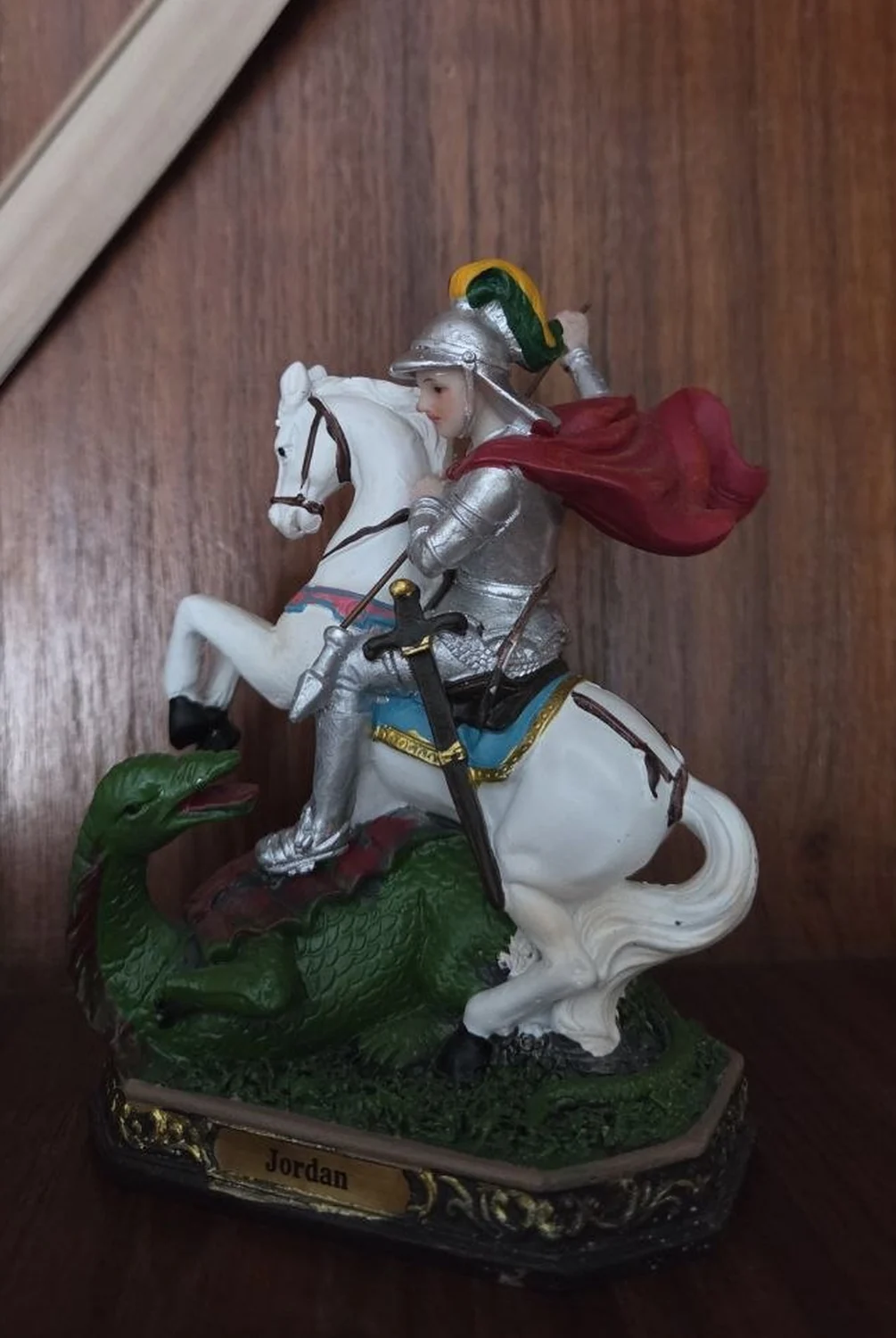
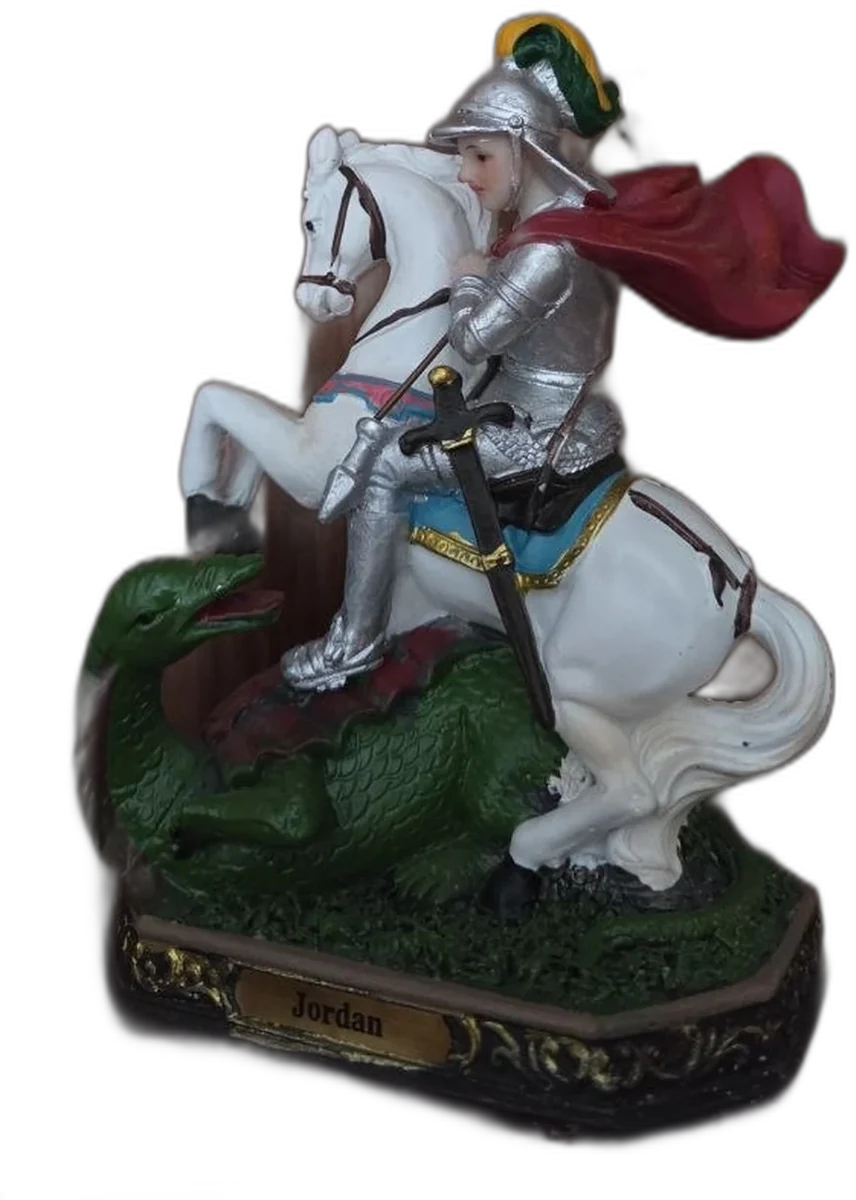
This sculpture gathers the whole of the legend into a single moment. A white horse rears; a knight in plate armour sits above it with his sword raised; beneath the hooves a green dragon is held down.
The armour repays attention. Plate of this kind belongs to the fourteenth century and not the fourth, and a soldier of George's generation would have worn mail and a helmet with cheek-pieces. This is no fault of the workshop but an inheritance: Western Europe met his devotion during the Crusades, and clothed him as one of its own.
The gold plaque on the base is engraved with a name, Jordan, which is no saint's name but a person's. Such plates turn a devotional figure into a gift, and whoever Jordan was, this statue was given in affection.
Section three
What the objects mean
Every element of the group carries meaning, and together they form a single profession of faith: that evil is real, that it is overcome, and that the victory belongs to God.
The horse is white, the colour given in the book of Revelation to the rider who conquers, and it is shown rearing rather than standing — a sculpture of great force held under a rider's hand.
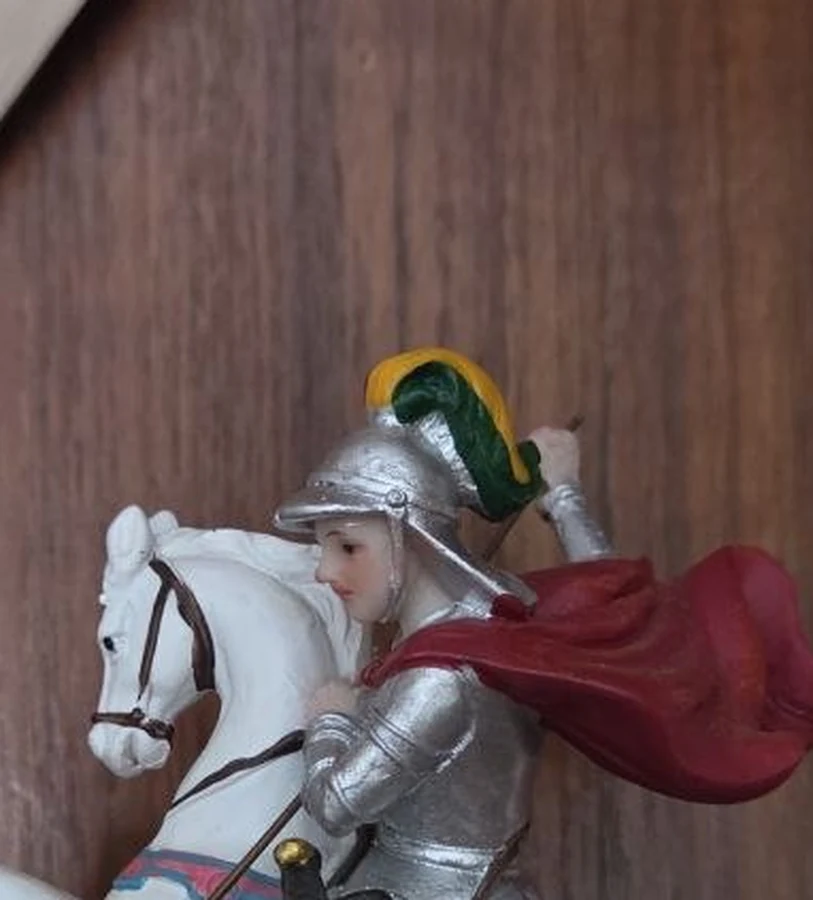
The knight, and the armour of a later age
Polished plate armour, a green plume, a red cape streaming behind, sword raised.
Plate armour of this kind dates from about the fourteenth century, a thousand years after George. The medieval West remade him in its own likeness because it met his cult during the Crusades, and so the most honoured dragon-slayer in Christendom wears the equipment of a crusader.
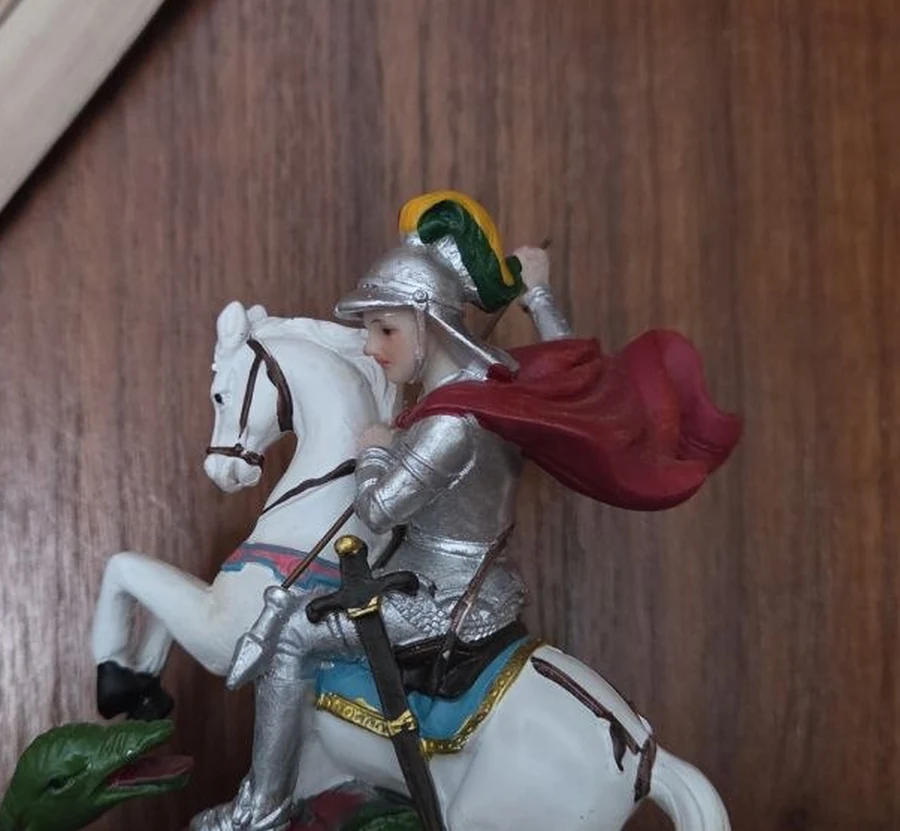
The white horse
Rearing, front hooves clear of the ground, harness in blue and gold.
White horses carry victorious riders in the book of Revelation. A rearing horse is also a device of the sculptor's art: it lifts the whole composition upward and makes the rider's calm appear as mastery rather than chance.
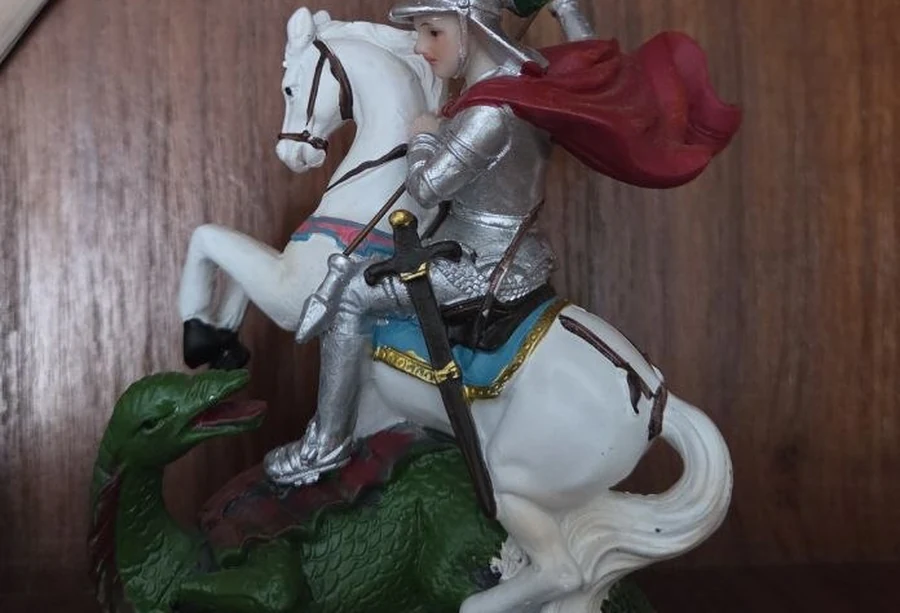
The dragon underfoot
Green, scaled, red-frilled, mouth open, one hoof planted on its body.
The dragon does not appear in George's earliest biographies. It is evil given an animal body, the same beast that appears in Revelation as the ancient serpent, and the foot set upon it is the oldest gesture in Christian art: the heel that crushes the serpent in Genesis 3:15.
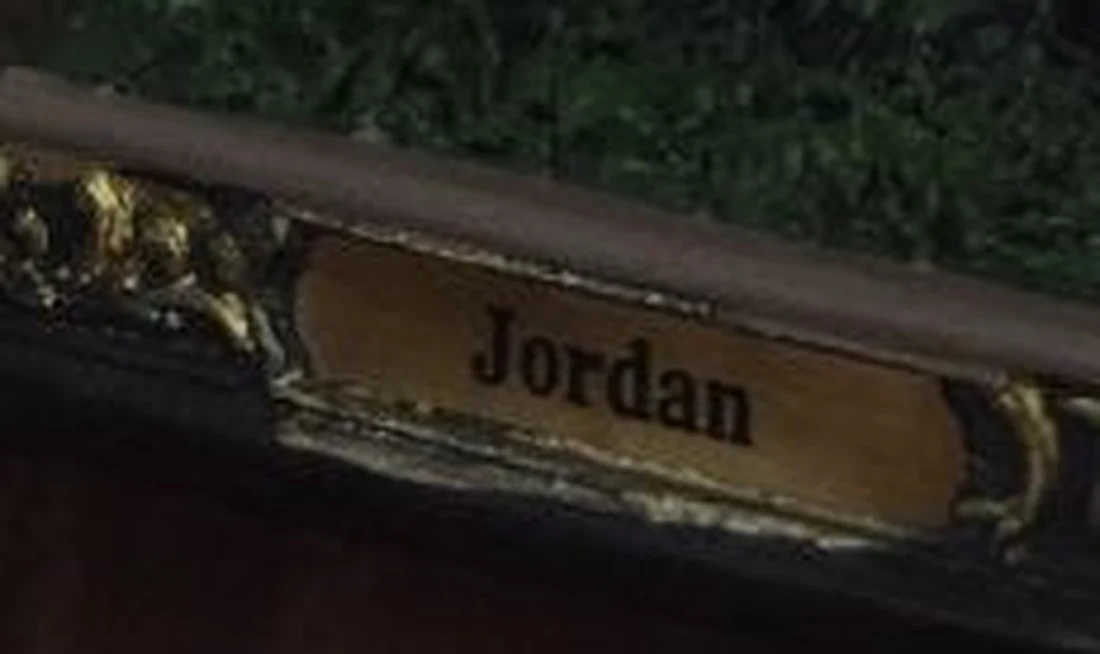
The name on the base: Jordan
A small gold plate on the front of the base, engraved with a personal name.
Jordan is not a saint's name; it is a person. Personalised nameplates turn a workshop figure into a gift, and they are found often on Iberian and Latin American pieces. Whoever Jordan is, this statue was addressed to him in love.
Section four
What Scripture says, and what it does not
George appears nowhere in the Bible, and his story is entirely post-biblical. It is told most honestly by distinguishing its three layers with care.
The first is history, and it is spare: a Christian soldier executed at Lydda on 23 April 303, during a persecution whose reality is beyond dispute. The earliest fragments of his written legend come from a fifth-century Greek palimpsest identified by Hippolyte Delehaye of the Bollandists, and the fullest early version survives in a Syriac translation of about the year 600.
The second layer is the literature of martyrdom, which grew as it was retold. In the Latin version Diocletian gives way to a Persian emperor named Dacian, the trial stretches across seven years and many tortures, and vast numbers are said to have been converted by the sight of his constancy. This is hagiography in its ancient manner, written to strengthen the faithful rather than to keep a record.
The third layer is the dragon, and it is the latest. The earliest known account of George and the dragon appears in the eleventh century in a Georgian source, and reached Latin Europe in the twelfth. In the Golden Legend of the thirteenth century a dragon terrorises Silene in Libya, the king's daughter is chosen by lot, and George kills the creature with a lance and refuses every reward but the conversion of the town. Read with reverence, the legend is a parable of deliverance, and of a stranger who stops what a whole city had agreed to suffer.
Then war broke out in heaven; Michael and his angels fought against the dragon. The great dragon was thrown down, that ancient serpent, who is called the Devil and Satan, the deceiver of the whole world.
Revelation 12:7–9
Section five
Why it sits on a shelf
George is the soldier's saint, and that has been his most constant service. Armies have carried him since the Byzantine age, and the crusaders brought him home as a patron of cavalry.
In the home his place is older and quieter. He is invoked against sudden harm — accident, violence and every evil influence — and for that reason is often placed near a door. On the Iberian peninsula, where sets such as this are made, he is a familiar household figure.
In India the devotion took deep root. Saint George came with the Portuguese and was received so warmly that many of the largest churches in Kerala bear his name, and there his feast is a parish festival rather than a private devotion. Somewhere in the history of this object a decision was made to engrave Jordan upon it: one person handing another a heavenly patron, and saying so in gold.
To Saint George, for courage
Saint George, soldier of Christ, you did not fear the anger of the emperor and you did not deny your Lord. Stand beside those who are afraid tonight, and beside those who are in danger; give them your courage, and give us the honesty to call evil by its name. Amen.
A modern composition rather than an ancient text. Older Catholic prayers to George are chiefly petitions against pestilence, war and sudden death, which is why he was numbered among the Fourteen Holy Helpers.